BOOKS

1992 1998 1998 1998 2000 2008 2009 2011 2014 2020
Eating The “I”: A Direct Account of The Fourth Way—The Way of Using Ordinary Life to come to Real Life
 | The search for one’s real self is a sacred quest, an archetypal journey, whereby the seeker eats through the web of illusory “I”s that mask his or her real self-identity. Dispirited and disappointed in life, the author’s life dramatically changes when he is introduced to the ancient, esoteric teaching of The Fourth Way—the way of transformation in ordinary life. Unique to this rich and practical teaching is its insistence that the student’s negativity and confusion are the sources of his or her awakening when rightly worked with. Life’s shocks and uncertainty—that which we most try to avoid—are in fact that which can help us to awaken. Lady Lucy Pentland “A fresh breath of air for the Work.” Miguel Serrano, author of The Serpent of Paradise, and Jung and Hesse: A Record of Two Friendships. “I am sure this book will be one of the more important writings on the Gurdjieff Work, after Ouspensky’s In Search of the Miraculous.” Richard Smoley, Editor, Gnosis “Eating the ‘I’ gives as full a picture of the Work as it may be possible to get without joining it … comes from a great depth and carries much conviction.” Charles T. Tart. Ph.D., Professor of Psychology University of California, author of Waking Up “Most books on the Work, while quite valuable, are too dry. Eating the 'I' is a major step in changing that: here we have a real human being, like you and I, struggling with Gurdjieff's teachings, sharing moments of despair and moments of insight and liberation. I found it hard to put the book down.” Robert S. Ellwood, Chairman, Department of Religion, University of Southern California “Eating the ‘I’ is about as good as it gets. Patterson is an excellent writer, with a gifted novelist’s ability to capture a character through a few lines of dialogue or seemingly casual notes on expression or dress. As for honesty about himself, Patterson’s work is in a class with Christopher Isherwood’s devastatingly frank, and brilliant story of his spiritual quest, My Guru and His Disciple.” Stephan Bodian, Editor, Yoga Journal “Patterson has two fine Irish gifts: a vivid memory and a storyteller's ear. Paced like a novel and filled with colorful characters, this spiritual autobiography is certain to appeal to those who want a rare and engaging inside glimpse of the Gurdjieff Work.” |
Struggle of the Magicians: Exploring the Teacher-Student Relationship
 | Of all relationships that between teacher and student is the most mysterious, most rewarding. That between Gurdjieff and Uspenskii, two of the seminal spiritual figures of the twentieth century, was titanic, archetypal. By closely observing their interactions, we come to understand the pattern of discoveries, resistances and rebellions—the deep inner and outer struggle that marks every teacher-student relationship, whatever the depth or path. Robert S. Ellwood, Chairman, School of Religion University of Southern California “An important contribution to the history of alternative spirituality in the West. The tension between the richly contrasting personalities of Gurdjieff and Uspenskii is a cameo of the problems with which the personal transformation tradition has had to contend. At the same time, their story illuminates in real life context the powerful vistas its visions have opened. It is the finely-told chronicle of a classic event in occult history, set against the backdrop of overwhelmingly dramatic historical events, effectively set into the narrative as datelines.” Colin Wilson, author, The War Against Sleep “Yes, what an excellent book—full of things I didn't know. A real contribution to our understanding of Gurdjieff and Ouspensky.” Robert Black, Editor, Living Traditions “The question of why Uspenskii (the Russian spelling of Ouspensky) left Gurdjieff is one of the more fascinating enigmas of The Fourth Way. Most students are first introduced to Gurdjieff through Uspenskii's In Search of the Miraculous. At first examination his works are easy to understand, well written and lucid, while the works of Gurdjieff are hard to fathom and at times seem confused, at least to the untrained eye. Patterson takes on a very difficult and sensitive subject; today many organizations see themselves as deriving from both Gurdjieff and Uspenskii or the students of Uspenskii and hence to “re-open this wound” is a daring thing to do. At the same time it is very necessary. Uspenskii was Gurdjieff's major student and offered the most intellectually credible outline of the teachings and yet he failed. He left Gurdjieff and indeed Gurdjieff's later work, including writing Beelzebub's Tales to his Grandson, all happened after Uspenskii left. “Patterson is not shy about expressing his opinions; he makes it clear that he believes Gurdjieff is the founder of The Fourth Way, indeed the “avatar” of that system, and that any talk of the Gurdjieff-Uspenskii work is just plain foolish. He believes that while Uspenskii's presentation of the work is superb, it is intellectual and “mental” alone and that the difficulty within the Gurdjieff material is deliberate, it forces us to work, to labor, so that we really appreciate the nature of the teachings we receive. Patterson does not degrade Uspenskii; he still sees him as an intellectual giant who published some highly significant works. Compared to us he was high achieving, but in a battle of giants the stakes are high. In the end, since the focus is on The Fourth Way as expounded by Gurdjieff then we must see Uspenskii in terms of his failure as a student and we must come to understand the psychology of that failure and its significance. Patterson is careful, however, not to allow this to overpower Struggle of the Magicians. He is careful to delineate where his opinions are expressed and limits these to the introduction, footnotes and last chapters. Too often books on contentious subjects end up as either polemic pieces brimming with opinion or dry recitations of facts with no relevance. Patterson has worked to bridge the gap and offer a highly original work which is both historically accurate and yet allows room for him to express his understanding of what occurred and why. “The historical aspect of this work is truly commendable. He presents the whole career of Gurdjieff and Uspenskii in chronological order, using source documents and coordinating a vast amount of material; he offers what is possibly the first historically accurate account of the life and work of Gurdjieff and how it intersects with his major students. He puts “The Work” within a world context, we read about what else is occurring at the same time—wars, massacres, changes of government, and these give an important background to some of the changes in the way The Work was expressed in the world. The balance of personal opinion, historical research using source documents, and the use of the context of historical events makes this quite an astounding book. Indeed I would suggest some historians could learn a thing or two about how to communicate through examining this volume! Struggle of the Magicians works on many levels, it is an historical text, well documented and interesting to read. It is a study of the relationship between Gurdjieff and Uspenskii as well as other students and offers insight into what occurred and its significance within The Fourth Way. It is also a study of the teacher-student relationship and how that has relevance within our own spiritual lives, even in 2007. This is a highly recommended volume.” Editor, Light of Consciousness “For many of us, Gurdjieff and Uspenskii have remained mysteriously attractive but dauntingly difficult to grasp. Struggle of the Magicians is a 'hard to put down' exception to much of the literature available about Gurdjieff, presenting his life and work almost like a play against the panoramic backdrop of his turbulent times, from World War I and the Russian Revolution through World War II. “The central focus of the book is the sacred, archetypal relationship of the Master and disciple. An intimate view is given of Gurdjieff's work with his students including many who, like the famous Uspenskii, were unwilling to pay the price. This revealing look at the roles of Guru and disciple in the compelling work of self-transformation makes the book of special interest and value to those on any path.” Jay McKinney, Gnosis “In his new book, William Patrick Patterson takes the question of why Ouspensky left Gurdjieff by the horns and offers one answer: Ouspensky left because he couldn't hack it. We can appreciate Patterson's Dos Passosesque presentation of the Gurdjieff-Ouspensky history without agreeing with his conclusions. “Patterson's thesis is that Ouspensky, Orage, and Bennett failed Gurdjieff and his mission to 'save the world from destroying itself' by not being able to surmount their respective 'chief features.' For Ouspensky, this meant his 'independence of mind.' For Orage, it meant his 'feelings,' evidenced in his marriage to Jessie Dwight against the druthers of his guru. And for Bennett, it was his 'thirst for adventure.' All of them, Patterson says, were magicians in their own right, and the 'struggle' was not solely between Gurdjieff and one of them, as their esoteric politicking shows. According to Patterson, each of these magicians 'developed in Gurdjieff's sense of the term.' But, he goes on to lament, 'none developed to a point where they could totally sacrifice themselves to Gurdjieff's mission.' Granting that Patterson understands 'Gurdjieff's mission,' one wants to ask: should they have? “Struggle of the Magicians is absolutely captivating for several reasons. Along with presenting one of the most exhilarating accounts of the history of The Fourth Way, Patterson shows why it is so much more difficult to write about Gurdjieff than about Ouspensky, Orage, or Bennett. All three were exceptional men, possessed of genius, but men nevertheless, with weaknesses and flaws. Gurdjieff, on the other hand, is a superman; or, as Orage called him, 'a kind of walking God.' “Patterson, too, is not adverse to invoking a divine pedigree when speaking of Gurdjieff. In a footnote about Ouspensky’s ‘distinction’ between the man and the ideas, Patterson comments that this separation is tantamount to ‘Peter separating Jesus from the Sermon on the Mount.’ I respect Patterson’s high estimate of Gurdjieff and for the most part share it—except when doing so means chiding Ouspensky, Orage, and Bennett for following their own inner directives against those purported to be the master’s. “At every interval of the Gurdjieff-Ouspensky octave at which Ouspensky exhibits any independence of mind, Patterson sees Ouspensky as failing to recognize that Gurdjieff was working on him. Stubborn, ‘fiercely independent’ Ouspensky never seemed to grasp that Gurdjieff’s wild, irrational, and frequently annoying methods were aimed at piercing the armor around his ‘emotional center.’ The stoic intellectual could not understand the crazy guru. “This assessment is valid for some, perhaps most, of the dynamic between Gurdjieff and Ouspensky, but it becomes tiresome as the punch line to every encounter between the philosopher and the holy man. It never occurs to Patterson that Ouspensky and Gurdjieff were two very different men; hence Ouspensky’s realization that Gurdjieff’s way ‘is not my way’ may be evidence of something more than pride and stubbornness. “In an analysis that resembles classic Freudian/Marxist counter criticism (you don’t accept your complexes/class slavery because you are ‘defensive’), Patterson reduces Ouspensky’s realization of his inner strength to simple lying. If you accept Gurdjieff’s infallibility—a pill, that for all his undoubted powers and genius and strength of being, some of us find difficult to swallow—then Patterson’s wrist-slapping will close the book on why the chela left his guru. But if you think the answer to why Ouspensky left Gurdjieff is altogether simpler—that Ouspensky was too dominant and original a mind to remain anyone’s disciple, as a reading of A New Model of the Universe or indeed In Search of the Miraculous will show—then you can take Patterson’s thesis (as fascinating, thought-provoking and irritating as his master) cum grano salis and enjoy reading this book nevertheless.” |
Taking with the Left Hand: Enneagram Craze, The Fellowship of Friends, & the Mouravieff ‘Phenomenon’
 | The first book to examine the spiritual theft and appropriation that marks our time. A detailed and well-documented study, it illustrates how the enneagram movement commercialized an ancient alchemical symbol, how Robert Burton, founder of The Fellowship of Friends, arrogated The Fourth Way teaching, and how Boris Mouravieff plagiarized and tried to appropriate it. Kindle Edition Available
Editor, Publishers Weekly “William Patrick Patterson’s Taking With the Left Hand deals with esoteric teachings in a modern context. In this collection of three essays about various aspects of the legacy of the influential spiritual teachings of G. I. Gurdjieff, the author tackles the enneagram craze, the teachings of Boris Mouravieff and a Gurdjieff splinter group, expanding his discussion of these relatively parochial issues to raise more universal questions about the nature and transmission of spiritual truth.” Robert S. Ellwood, Chairman, School of Religion University of Southern California “Taking With the Left Hand is a lucid and compelling account of conflict and charlatanism surrounding one of the most important alternative spiritual movements of our day. Indeed, one sees the crisis unfold before one’s eyes, for the author does not hesitate to charge those he finds responsible for debasement of the message of George Gurdjieff with opportunism and self-inflation. This book is important as a ‘white paper’ for those concerned about the fate of the broader Gurdjieff movement and as a case study for all students of contemporary spiritual movements.” Colin Wilson, author, From Atlantis to the Sphinx “Taking With the Left Hand is quite remarkable. I have read it with great pleasure. Patterson always writes absorbingly.” |
Ladies of the Rope: Gurdjieff’s Special Left Bank Women’s Group
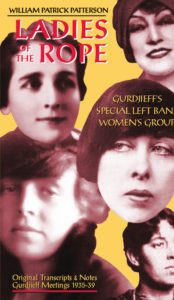 | This is the first book to examine the Rope, the women-only group of spiritual seekers, which G. I. Gurdjieff formed in 1935 on Paris’ Left Bank. During his thirty-seven years of work in the West, Gurdjieff’s creation of the Rope remains his most enigmatic group. As to why Gurdjieff created the Rope, the author’s conclusions are as original as they are surprising and have proved to be of serious interest to those involved with feminine spirituality in all its many forms. Kindle Edition Available Colin Wilson, author, The War Against Sleep “In the field of Gurdjieff/Ouspensky studies there is no one I respect more or regard as having more authority than William Patrick Patterson.” |
Voices in the Dark: Esoteric, Occult & Secular Voices in Nazi-Occupied Paris 1940–44. Including transcripts from 31 of Gurdjieff’s wartime meetings.
| Weaves together the oppression, fear and courage of those living under the Nazi occupation of Paris with the transcripts from 31 of G. I. Gurdjieff’s wartime meetings. Camus, Malraux, Sartre, Beauvoir, Gide, Daumal, De Gaulle, Churchill, Hitler, Stalin and many others speak to the time. Explored in depth is the little-recognized but powerful influence of the pseudo-occult in the ideology at the foundation of Hitler’s vision. Kindle Edition Available Editor, Publishers Weekly “Few spiritual figures have inspired as much controversy as G. I. Gurdjieff (1866–1949), the Greek-Armenian mystic who has been called the Father of the New Age. In this unusual volume, Patterson, who has written about Gurdjieff and his students before (most recently in Ladies of the Rope), presents a striking picture of Nazi-occupied Paris, juxtaposing an informed and sensitive history of those caught in the city with q&a transcripts of the meetings Gurdjieff held with his followers at his city apartment. The book’s epilogue carries a quote by Gurdjieff that highlights his uniqueness: ‘I not interested in who wins war. Not have patriotism or big ideals about peace. Americans, with ideals, kill millions of Germans, Germans kill-with own ideals—English, French, Russian, Belgian—all have ideals, all have peaceful purpose, all kill.’ These words may horrify many, yet this same man, Patterson makes clear, arranged to have Jews hidden and fed the destitute during the war years. The history Patterson presents of the events leading to the Nazi invasion of subsequent complicity and of resistance gives a vivid sense of a world rent by madness. By contrast, the extensive transcripts depict a world ruled by reason, as Gurdjieff’s followers struggle toward self-knowledge under his guidance: surely a living metaphor for Gurdjieff’s message of a true Self hidden within the turbulent self of everyday suffering, and an active explanation for the seeming dissonance between Gurdjieff’s actions and his expressed indifference about who might win the war. This book succeeds on several levels. Its primary appeal, of course, will be to those who relish yet more words from Gurdjieff; however, anyone curious about Paris during WWII, and more broadly about the psychology of those under extreme pressure, will find it of great interest.” |
The Life & Teachings of Carlos Castaneda
 | What were the sources of Carlos Castaneda’s teaching? Here, shown concept-by-concept, the primary source is revealed—Gurdjieff’s Fourth Way. Also explored is don Juan’s true identity, the meaning of Castaneda’s “jump into the abyss,” the life of the Nagual and his witches. Also included in full is the first reference to Nagualism, anthropologist Daniel Brinton’s essay “Nagualism: A Study in Native American Folklore and History” written in 1894. Watch the film: William Patrick Patterson Explores The Life & Teachings of Carlos Castaneda Margaret Runyan, author, A Magical Journey with Carlos Castaneda “A must read for anyone who has followed my husband Carlos on his extraordinary journey. The way William Patrick Patterson expounds on Carlos’ teachings is astounding!” C.J. Castaneda “This is the most brilliant and insightful rendering to date of the ‘Ultimate Impeccable Warrior,’ Carlos Castaneda, my father.” Colin Wilson, author, The Outsider and The Occult “Although inclined to skepticism about Castaneda, I found myself reading The Life & Teachings of Carlos Castaneda with total fascination. As it tells just about everything, I imagine this will be the definitive book on Castaneda.” Mary Ellen Korman, author, A Woman’s Work: The Life of Ethel Merston “Patterson brings original insight into the forces and influences that formed Castaneda’s sorceric adventure. Particularly interesting are the role of Anaïs Nin and the revelation of the source of many of Castaneda’s supposedly sorceric ideas.” |
Spiritual Survival in a Radically Changing World-Time
 | Spiritual Survival warns of Technology’s challenge and how it can spur us to awaken to a new integration of body, senses and mind. Explored in great and original depth is how the seminal teaching of G. I. Gurdjieff’s Fourth Way—the teaching for our time—offers the esoteric keys and practices to self-awakening in a radically changing, high-voltage and mercurial world-time. James A. Cox, Editor-in-Chief, Midwest Book Review “In a world quickly becoming dominated by soulless machines, how does one keep one’s soul? Spiritual Survival in a Radically Changing World-Time is a guide to spirituality in a technology driven world. Rather than shunning technology and loathing it, William Patrick Patterson tells readers to consciously embrace it as part of their lives and learn to control it instead of letting it control oneself. Spiritual Survival is a strong choice for those feeling something is missing in their lives.” Editor, Arizona Networking News “Explores the seminal teachings of G. I. Gurdjieff’s Fourth Way in great and original depth through a detailed introduction, illustrative meetings and probes and essays of key esoteric ideas and practices of how to self-awaken in this radically changing world-time. In this seventh and final book on Gurdjieff’s teaching, William Patrick Patterson warns that unless we learn to control Technology, it will control us. We will lose our spiritual heritage and simply become machine-like worker ants. Patterson holds that Technology is not different from us—it is simply our rational part developed to an extraordinary binary degree. To understand it, we must first understand ourselves and our potential which is the focus of the teaching.” Diane C. Cox, Editor, The Bookwatch “G. I. Gurdjieff’s Fourth Way is an ancient spiritual teaching for modern times which directly confronts technology and its potential for damaging spirituality. Spiritual Survival in a Radically Changing World-Time is a teaching guide presenting not just the concepts, but how to actually apply them in our ordinary lives. Case history examples pack a survey of philosophical and psychological ideas to complete a context that lets us know where we are, how we got there and what to do about it.” |
Adi Da Samraj–Realized or/and Deluded?
 | The first critical assessment of the life of Adi Da Samraj, a.k.a. Franklin Jones, and his teachings. Introduced first to The Fourth Way Teaching and practices, he then became involved with Swami Muktananda. Young, hip, articulate and funny, this first American-born guru had a meteoric rise, bringing him thousands of seekers until the sex scandals brought a public shaming and his withdrawal to a Fijian island hermitage where he, now Adi Da Samraj, announced he was God Incarnate. Robert Black, New Dawn Magazine “What are we to make of Adi Da? He began as simply Franklin Jones (born in 1939) and ended his life claiming to be an avatar, a perfect incarnation of the universe in whose very presence illumination would be achieved without effort. He lived on his own island near Fiji and from there spread his message as the ultimate guru. His books became more and more obscure with their own unique grammar and terminology. He may be strangely compelling, but was he a voice of enlightenment? That’s the question William Patterson sets out to answer. Jones’ early training was through his own drug based experiences, then with Albert Rudolph who taught Kundalini Yoga and his own version of Gurdjieff’s Fourth Way. Jones continued to study a myriad of systems from the Lutheran form of Christianity to Scientology. Under Swami Muktananda he had many visions and experiences which led him to develop his own unique teaching and the publication of his first books. In 1972 he opened Ashram Books (later called Dawn Horse Books) and offered his first public teachings. He broke with all his teachers and offered his own path to experiencing the divine including a method of breaking traditional sexual mores with a Western form of Tantra. He attacked the “cult of pairs” and notions of marriage which ultimately led to the so-called “Saturday Night Massacre”—the night when he initiated new teachings on relationships. The radical methods he used shocked his bourgeois followers, but it did have parallels with crazy wisdom traditions in Hinduism and Buddhism, as well as the heterodox sexual method of Tantra. Using such methods on Westerners brought problems including all manner of legal cases. In 1979 he declared himself Da Free John, an incarnation of god, and in 1983 moved to Naitauba Island, Fiji. Celebrated by some, he was more often attacked by others, and he gradually withdrew from the outside world. He never believed the world truly understood his teachings, and died a sad figure on 28 November 2008, aged 69. Following an exhaustive biography that is objective and critical, William Patterson presents a clear and insightful analysis of Adi Da’s teachings. He points out what he sees as misunderstandings within Adi Da’s teachings, and the cost of his crazy wisdom approach. While his teachings can be seen in terms of the more radical forms of Hindu and Buddhist Tantra, one has to wonder if Adi Da fully appreciated the devastating effect of these methods. Or perhaps the sheer power of these unleashed metaphysical forces overwhelmed self discipline. Any Tantric technique demands immense Will and self control, otherwise the practitioner will be outmaneuvered by the Ego, the very thing they are trying to transcend. It seems that ultimately Adi Da became ensnared between the two. Patterson offers a challenging examination of Adi Da and leaves it for the reader to make judgments. The question often dealt with is how to understand Adi Da’s supposed illumination with his narcissism and extreme behavior, that continued for so long after it had supposedly served its purpose of shocking his students out of their mental chains. It is one thing to use sex to shock your students; it is another to become seemingly addicted to the path of excess, overtaken by the power of indulgence, or Tamas in Hindu terms. Adi Da Samraj: Realized and/or Deluded? is a critical and well researched examination of Adi Da, his crazy wisdom and heterodox techniques, and the human costs.” Teresa Adams, The Gurdjieff Journal William Patrick Patterson’s newest book, Adi Da Samraj: Realized or/and Deluded, is the first evenhanded and detailed exploration of one of the most enigmatic, self-styled spiritual gurus of the last half of the 20th century. America’s first young, hip guru, Adi Da Samraj, né Franklin Jones (1939–2008), self-proclaimed Avatar of Avatars, not only of this age but all ages to come, had a meteoric rise and subsequent fall after devotees went public with his crazy wisdom teaching of sex, drugs and alcohol. Totally committed to spiritual realization, Jones took only six years to realize Sahaj Samadhi, the pointless point of view. Preceding this was a copious use of drugs, and then contentious relations with his two teachers, Albert Rudolph (“Rudi,” later Swami Rudranada), a former student of Gurdjieff’s Fourth Way, and Swami Muktananda. Intuiting that everyone unconsciously lived the Narcissus myth of separation and denial as he had, Jones founded what he believed was a radical new teaching combining elements of Kundalini Yoga, Fourth Way, Buddhism and Advaita Vedanta along with the acceptance of himself as God incarnate. To break through the narcissism that blocked devotees’ spiritual realization, he persuaded them to enter into sexually shocking situations with himself and each other. Though experience proved this method hurt far more than helped, Adi Da insisted on what he called “sexual theatre,” later renamed “sexual communion,” until his last days on the remote Fijian island hermitage to which he had withdrawn. After tracing Adi Da’s life from beginning to end, Patterson gives a penetrating analysis of the key concepts of the teaching before coming to the heart of the question—How can someone be realized at the highest level and act this way with his devotees? Adi Da always maintained that realization does not destroy “the person,” so just who was his “person”? From a careful reading of Adi Da’s books, Patterson gleans an assemblage of facts pointing to a hidden wound that usurped Adi Da’s realization for its own ends, giving an archetypal example of “wrong crystallization.” The esoteric and spiritual questions Adi Da Samraj—Realized or/and Deluded raises are acutely seminal and ones every seeker and adept needs to long ponder. |
Georgi Ivanovitch Gurdjieff — The Man, The Teaching, His Mission
| Ten years in the making, it is the deepest study yet of this potent, seminal spiritual figure of the last century, his teaching of The Fourth Way, and his Mission. Material from the library archives of Gurdjieff’s direct students, much of it not available until recently, and all relevant books written about Gurdjieff have been integrated and assembled in chronological form. The aim is to give an objective, panoramic view of his life, the inner substance of the ancient teaching of spiritual self-development, and his unrelenting mission to introduce and establish The Fourth Way in the West. Jeff Zaleski, Editor-in-Chief, Parabola magazine “Patterson is one of today’s best-known authors of books about the spiritual master G. I. Gurdjieff and his teaching. . . . An expertly assembled narrative—a chronological mosaic of the activities, inner and outer, of Gurdjieff and his followers. . . . In its range and depth, this account ranks with James Moore’s Gurdjieff: An Anatomy of a Myth and James Webb’s The Harmonious Circle as a vivid portrait of the great and enigmatic teacher and of the men and women he taught.” Steve Young, Editor, Library Journal “Patterson follows up earlier books and film documentaries on Gurdjieff with this detailed, indeed exhaustive, compendium of primary and secondary source materials. The bulk of the book is a chronological account. . . . Patterson stitches these passages together with brief connecting paragraphs written in the historic present, which gives the book a remarkably strong narrative flow.” James A. Cox, Editor-in-Chief, Midwest Book Review “An impressive work of definitive scholarship. Enhanced with photos and essays, as well as extensive Notes, a Chronology, lengthy roster of References, a list of all Gurdjieff students, impressive Bibliography and a comprehensive Index. A critically important resource and reference for students of Gurdjieff’s work, it is an indispensable addition to academic library reference collections.” Robert Black, Editor, Living Traditions “Patterson is considered by many, myself included, to be the most significant teacher of The Fourth Way today. . . . He has always presented the tradition without distortion or obscuration . . . his transmission of the teaching has always been incisive, clear and rigorous. The book is a work of incredible dedication . . . the most accurate and comprehensive biography of Gurdjieff and Ouspensky currently available. Patterson also gives one of the most extensive expositions of The Fourth Way with exceptional clarity and succinctness. Being succinct is an art, it means ignoring literary pretensions and ego aggrandizement and using words carefully and with immense care. Patterson’s way of writing is direct and without undue padding; others writing this 668-page volume would have made it three times the size. . . . The reference materials included in this volume are rare and include such never-before-published essays as Uspenskii’s “Why I Left Gurdjieff” and “Where I Diverge from Gurdjieff”; original deleted material from Search; Uspenskii’s American femme fatale, Carman Barnes; Jessie Dwight Orage’s short stories “Elsie at the Prieuré” and “Elsie and Allah”; notes of Kathryn Hulme and Solita Solano (1935–39); The Science of Idiotism; and the complete scenario of Gurdjieff’s ballet, The Struggle of the Magicians.” Tom Bunzel, Collective-Evolution.com “Georgi Ivanovitch Gurdjieff: The Man, The Teaching, His Mission is a work of immense power and love by William Patrick Patterson, a teacher of “the Work,” as Gurdjieff’s teaching is called and the author/producer of several books and videos on the subject. It is over 600 pages long (over 400 narrative with 200 supplementary) and is a painstakingly precise account of two figures little known in the mass media, almost overlooked in popular history, and yet who may have been among the greatest thinkers of their time.” |
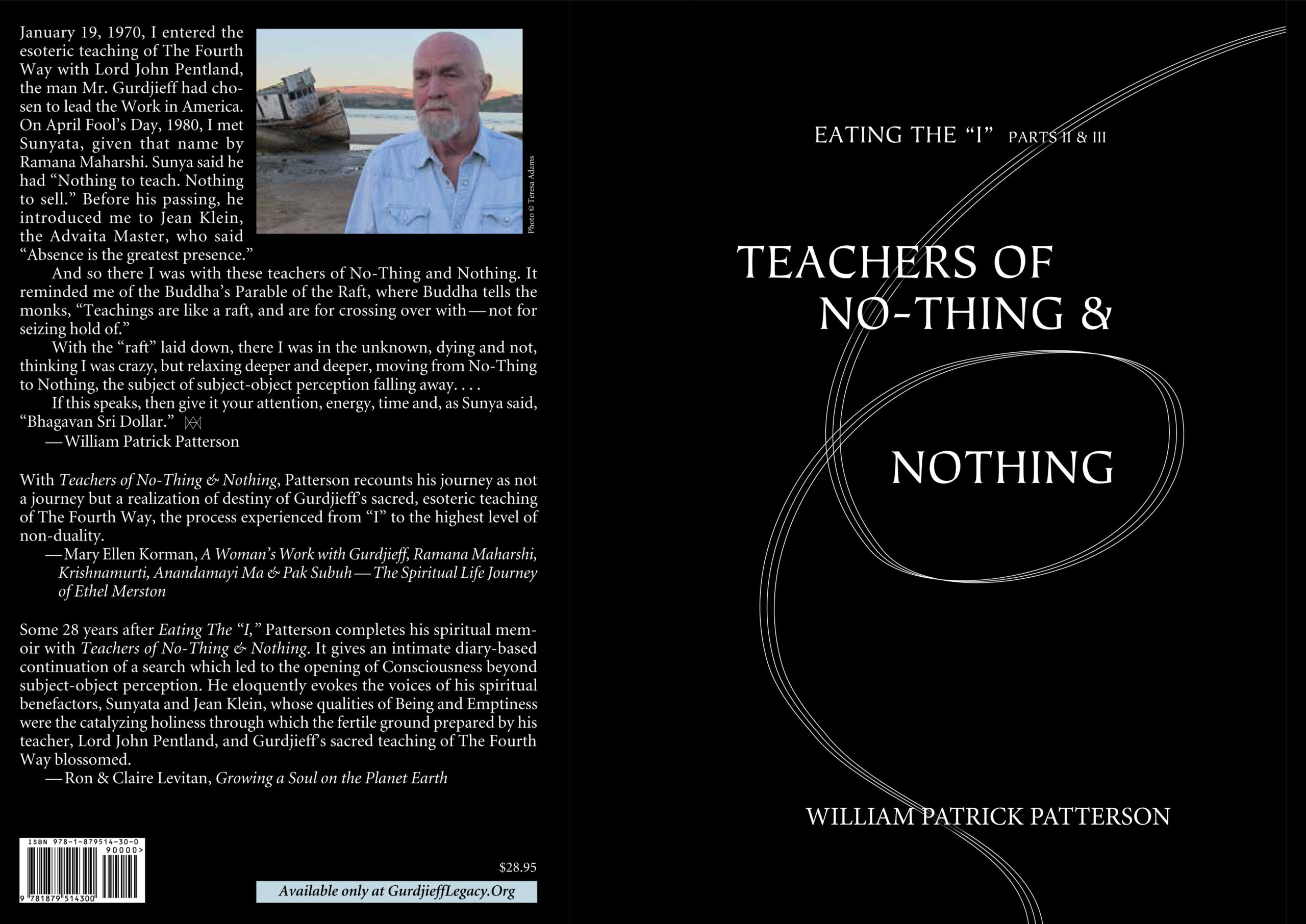
Teachers of No-Thing and Nothing: Eating The “I” Parts II & III
| With this book, his tenth and last, William Patrick Patterson completes his spiritual memoir. Eating The “I”, the first part, published in 1992, focused on his experience with his teacher Lord John Pentland, the man Mr. Gurdjieff chose to lead The Fourth Way in America. Questioning what is the self in self-remembering brought Patterson to the Dane Alfred Sorensen, given the name “Sunyata” by Ramana Maharshi who saw him as a rare-born mystic. Sunyata told him, “The witness is a high state, but only a state.” Through Sunyata, he met Jean Klein, the European Advaita master who holds that “Absence is the greatest presence.” Mary Ellen Korman, Author, A Woman's Work with Gurdjieff, Ramana Maharshi, Krishnamurti, Anandamayi Ma & Pak Subuh—The Spiritual Life Journey of Ethel Merston “With Teachers of No-Thing & Nothing, Patterson recounts his journey as not a journey but a realization of destiny of Gurdjieff's sacred, esoteric teaching of The Fourth Way, the process experienced from “I” to the highest level of non-duality.” Ron & Claire Levitan, Authors, Growing a Soul on the Planet Earth “Some 28 years after Eating The “I,” Patterson completes his spiritual memoir with Teachers of No-Thing & Nothing. It gives an intimate diary-based continuation of a search which led to the opening of Consciousness beyond subject-object perception. He eloquently evokes the voices of his spiritual benefactors, Sunyata and Jean Klein, whose qualities of Being and Emptiness were the catalyzing holiness through which the fertile ground prepared by his teacher, Lord John Pentland, and Gurdjieff's sacred teaching of The Fourth Way blossomed.” A Fourth Way Teaching Book Itself on Many Levels IT'S NOT A MYSTERY what happened after Eating The “I”, Part I, or those of us actively engaged under the guiding direction of Fourth Way teacher William Patrick Patterson for we are the recipients of that Work. For others having read at the end of Part I that the author left the New York Gurdjieff Foundation must naturally create a question. Patterson's most recent three decades have produced a serious and significant body of work, including ten books, along with eight films, four of them filmed on location in Armenia, Georgia, Turkey, Egypt, Russia, France and England—and all focused on Mr. Gurdjieff and The Fourth Way teaching. But what exactly happened following the end of Eating The “I” and that period that begins these past three decades—of unflagging efforts and undeterred pace—that gave birth to such a profound legacy, inclusive of leading Fourth Way Groups, taking the role of teacher, giving talks, seminars, retreats, as well as founding and editing The Gurdjieff Journal while simultaneously writing books and producing films? This tenth book, Teachers of No-Thing & Nothing, Parts II & III, an intriguing and revealing title, is not only a surprising response to this question but a deeply moving one. A spiritual autobiography and continuation of Part I—yes—but written in an uncommon style: chronological diary entries that include teaching dialogues from his two nondualism teachers (hence Parts II & III ), who Patterson refers to as his Benefactors: Sunyata, the Danish “rare-born mystic,” given the name by the Sage Ramana Maharshi, and Jean Klein, the French medical doctor—both from the Advaita Vedanta Tradition. Patterson couldn't have known at the time that he left the organized Work in October 1981 that his teacher, Lord Pentland, would leave the body a little over two years later in February 1984. And yet we hear, through Patterson's recounting of dreams, that for years afterward Lord Pentland would continue to speak to him, indicating the depth of their bond. What can now be seen as his introduction into the teaching of nondualism had already begun in April 1980 when he met Sunyata and heard him state in his simple manner, “The witness is a high state, but it's only a state.” For Patterson, this was a new awakening—a catalyzing shock reflecting back to him in recognition that this is where one is. His inner work thus far had brought him to the state of the Witness, one of conscious attention and inner emptiness. But don't we all believe that our attention is already conscious and consciously being directed? To understand what the Witness represents, we simply need to return to the body-mind sensation, self-observe and verify for ourselves that the ordinary state of attention is a mechanical oscillation between subject or object. That is, we are either all subject, me-myself-and-“I”, or, all object, the attention projected outwards onto the world of objects, sentient or not. So, the impressions received are necessarily limited and partial. For the Witness, on the other hand, the weight of attention is grounded in Being, and comes to fruition only when the body-mind has digested the food of Work-on-oneself to a living inner emptiness and stillness. Only then, can the simultaneous subject-object Witnessing occur and its nature is the fullness of impartial perceiving. Although similar to Part I, which presents the life story in vivid and revealing form, Parts II & III provide an illustration into the process of awakening—seeing, dropping and going beyond the person—but now from within a new context of deeper discrimination and impartiality—that of the Witness. The one writing and reporting on “Patterson” is possible only because he has gone beyond “him.” It is rare enough to read a spiritual autobiography, and rarer still, one rooted in The Fourth Way, by “a man who takes on himself the role of teacher.” [Emphasis added.] But Patterson does not obfuscate the quintessential problem to liberation: the person—no matter how rarefied the “I” that must be consciously eaten. Through Sunyata, Patterson was availed of the beginning contact that would bridge the gap between the Work understanding of the many “I”s through to the Witness, and a forefeeling of the response to his own question as he states it, “…the perspective of duality no matter how refined did not answer the essential question I had been carrying all these years—what is the self in self-sensing, self-remembering, self-observation?” Although not formulated or assimilated at this point, Patterson is opened to a new awaring that the self in his question lies beyond the Witness. This second approach, transmitted through Klein, seems to have given a certain ground to Sunyata's Ocean of Emptiness—one that embraced Gurdjieff's teachings on Unity, the Law of Seven, Law of Three and the Ray of Creation, as echoed in his statement, “Matter or substance necessarily presupposes the existence of force or energy. This does not mean that a dualistic conception of the world is necessary. The concepts of matter and force are as relative as everything else. In the Absolute, where all is one, matter and force are also one.” On the level of the mind, ordinary understanding, the nearest we can come to objectless truth is a clear perspective, a vision of the objectless. I often call this a geometrical representation. The contents of this representation are what could be called the facts of truth: that the mind has limits; that truth is beyond the mind; that truth, our real nature, cannot be objectified, just as the eye cannot see itself seeing; that truth, consciousness, was never born and will never die; that it is the light in which all happenings, all objects, appear and disappear; that in order for there to be understanding of truth, all representation must dissolve. When this representation, the last of the conventional subject-object understanding, dies, it dissolves in its source—the light of which the mind informed but could not comprehend. In other words, understanding dissolves in being understanding. We no longer understand, we are the understanding. This switchover is a sudden, dramatic moment when we are ejected into the timeless. Having actualized the geometric understanding, Patterson later comes to the experiencing of “the gradient between the waking state and the subconscious lessening to the degree that the former is assimilated in the latter”—this is what Klein called, “the Blank state.” Patterson describes it as “still in subject-object perception but where there was very little subject.” Then, four years later, he is imprinted in the Being Reality that Klein, Sunyata, Lord Pentland and Gurdjieff had all been pointing towards. That is, he suddenly experiences pure Consciousness, beyond subject-object. As he says, “…suddenly there was no subject. There was no perceiver, no thought. Only perceiving—direct, global conscious perception-reception of what is present without referent to past or future.” “What was experienced,” Patterson recognizes, “was Turiya, the fourth state of the Self…” And, it is what five years earlier Klein had been speaking to when he told him: The moment there is a “watching” that projects energy in space and time there is taking, attaining, grasping. It is an activity whose source is memory, not being. But the moment you welcome the perception, you are in the receiving position and projection dissolves completely. And, suddenly, you are taken by your own presence (which is not a subject-object relationship)…. It is the point of being completely free of all volition, personal volition. You are really a channel. This realization of the transmission—Turiya—was the response to his question: “…what is the self in self-sensing, self-remembering, self-observation?” Gurdjieff could have easily said “sensing,” “remembering,” “observing,” so why, “self”? …In his inimitable way, Gurdjieff buries the clue in plain sight. What can be so easily missed, given the format of diary entries in which Patterson is not narrating an interpretation of the lived experiencing, is that during the period from 1979 through 1989, Patterson had gone through five rewrites of Eating The “I”. At the time, obviously, there was no “Part I” as a subtitle. So while Teachers of No-Thing and Nothing is about Sunyata and Jean Klein, it is deeply about the silent current of his spiritual roots in The Gurdjieff Work, occurring simultaneously as punctuated by the appearance of Lord Pentland in dreams along with the conscious and intentional writing of Eating The “I”— “wishing and willing,” as he says, “to get as close to the bone of the truth as possible.” While the rational mind expects and even demands neat, straight lines in life, Patterson writes of the new direction his journey would take beginning with his “Charles Fort” dream in 1975 where Lord Pentland hands him an envelope containing a white card inscribed in calligraphy telling him, “It's one of the original invitations.”; it is fated that he must leave the organized Work. Could it be he was being prepared since Lord Pentland would leave the body in 1984?… “Transmission,” Klein told him, “doesn't mean doctrine. It is not the doctrine that is transmitted, but the Truth, the Truth of reality. Tradition in the real sense is That which is transmitted from one who knows, who is the Truth, to another who is also . . . but has yet to realize it.” Beyond the personal story of a teacher in The Gurdjieff Tradition, however, is something else of serious import regarding the deep message of this book as it relates to The Gurdjieff Work itself. If we consider the spiritual idea of being called, what is the context within which Patterson publishes Eating The “I” and begins these past three decades reconnecting the roots of Gurdjieff's sacred teaching of The Fourth Way? The Gurdjieff narrative that had formed from the 1970s and 1980s was largely being defined in the public arena through a proliferation of faux Gurdjieff groups, communities, and Enneagram “scholars” putting forth concoctions met by a simultaneous New Age wave of young adults yearning with spiritual hunger. Even within established, authentic Foundation groups could be heard the incorrect notion in using the expression, “Gurdjieff-Ouspensky Work.” Not only did these errors, deviations and distortions require correction but the great need for the wholeness of The Fourth Way teaching called for its expression reconnecting it back to its source: Gurdjieff Sri Anirvan, the Bengali Master and Vedic scholar, once told his student Lizelle Reymond, who later became Madame de Salzmann's student: All life is from the Void…. The Void is the matrix of universal energy. One has access to it by four stages. The first stage is to realize the plurality of 'I's; the second stage is the recognition of a single 'I'; the third, is no 'I'; and finally the Void. Uspenskii speaks about the first two stages in Search of the Miraculous. He remained silent about the last two because he had left Gurdjieff. The writings of Gurdjieff [All & Everything] open for us the frontiers of the two last stages. These are cleverly hidden in his mythical narrations. But for those with a sincere Wish to awaken, the deep and great scale of Gurdjieff's teaching, accessible by the four stages, no longer remains a mystery or hidden. The real title of Gurdjieff's Legominism, as Patterson reveals, is: ALL & Everything & No-Thing & Nothing—Teresa Adams |